Guides · the catalogue
Eighty-nine muay thai combinations, and what each one costs to throw
This is the whole list the app calls from. It is sorted by how long each one takes on the bag, which is a more useful order than difficulty: it is also the answer to why a round timer that beeps on a steady beat cannot call muay thai.
The catalogue as of version 1.1.0 · 16 September 2026
The shortest call is 0.35 s. The longest is 4.95 s.
A jab is 350 ms, contact to contact, measured on ten competition boxers filmed at 240 Hz. A muay thai roundhouse is 1,020 ms, heel down to heel down, measured at 500 Hz. Then the bag swings away and takes most of another second to come back to where you can hit it.
Stack those and the spread is enormous. jab is 0.35 s. jab · cross · low kick · lead hook · cross · body kick is 4.83 s. Three low kicks in a row is 4.95 s. That is a factor of fourteen between one call and the next.
Pick any fixed interval and do the arithmetic. Three seconds rushes every combination over four seconds long — the shin is still in the air when the next call arrives — and leaves you standing for two and a half after a jab. There is no single number that works, which is the entire reason this app computes the gap per call rather than letting you set one.
The times below are the strikes plus the bag's return. They are not how long the app waits: rest between combinations is its own dial, and it is set per combination rather than once for the session.
The list
Three tiers, each sorted from the quickest call to the longest. A · separates the beats. A + joins strikes thrown as one motion, which is a group and is never cut in half. lead and rear follow your stance: the app knows which one you are in and calls accordingly.
Tier one — one weapon, called on its own
A kick from a standing start is a different skill from a kick at the end of a chain, which is why these are calls of their own and not only the tail of something longer. 28 of them.
Tier two — hands into legs
The link is the skill. A punch turns the body, and the kick behind it either picks that rotation up or fights it. 29 of them.
Tier three — four beats and up, feints, clinch, counters
The longer sequences, the ones with a lie in them, the ones that start from a defence, and the ones that end in the clinch. 32 of them.
What the catalogue deliberately does not have
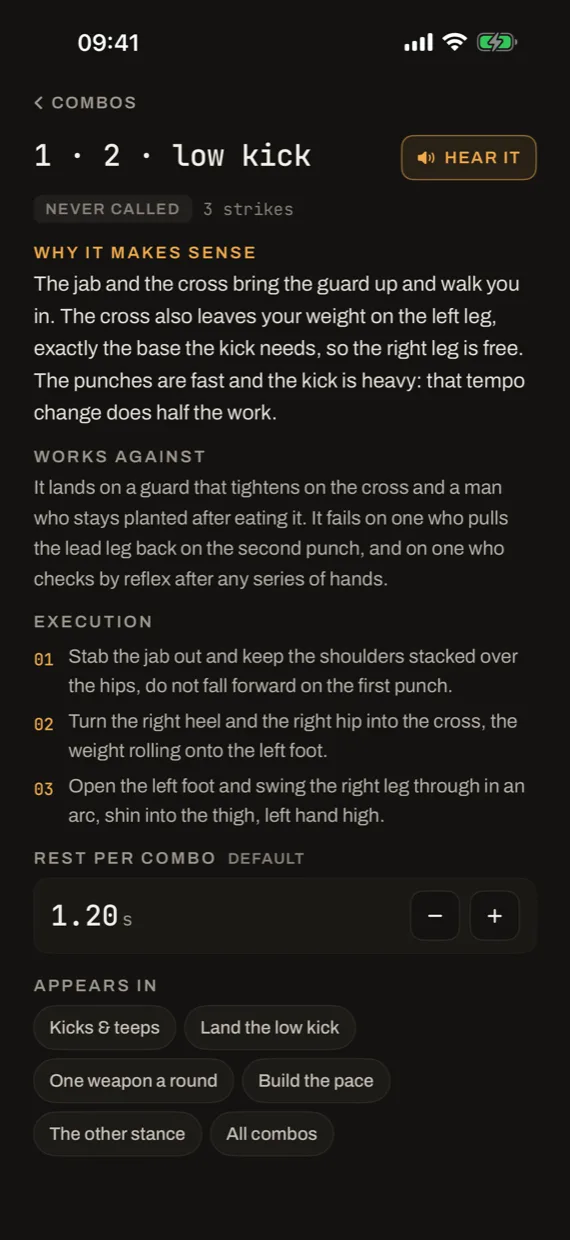
What it does, who it works on, how to stand.
Nothing past six beats. It is an invariant the test suite enforces rather than a guideline. A seven-beat call is a call nobody finishes.
Nothing invented. There is no entry here because it sounded good. Every one traces to a named coach or a published curriculum, and a program built on combinations with no source fails the build.
No numbers past four. 1, 2 and 3 are stable in every gym. 4 through 6 exist in the lexicon, but no program leans on them alone, because they stop being portable the moment you change gyms. Everything is also said in full words when it is called, which is the difference between a call you can follow with the phone in your pocket and a call you have to look up. Seven reviews in the wider category are about exactly that.
Nothing about your body. The app has no camera and no sensor. It knows which calls it made and nothing else, and no screen in it says otherwise.
Straight answers
About the list
Where do these combinations come from?
Each one is in the catalogue because a named coach or a published curriculum put it there — numbered hand sequences from boxing, the Dutch four-count from Dutch kickboxing, hands-into-legs links, clinch entries, counters off a check or a catch. The app's own test suite fails a program whose source line is missing, which is how the rule is held by the data rather than by good intentions. The sources are kept in the data and no screen prints them: they are there to keep the catalogue honest, not to decorate it.
How is the time calculated?
Every strike carries a cost and, where the bag is knocked away, a recovery. A punch inside a combination is 350 ms contact to contact (Piorkowski, Lees & Barton, 2011, ten competition boxers filmed at 240 Hz). A muay thai roundhouse is 1,020 ms heel-down to heel-down (Gavagan & Sayers, 2017, at 500 Hz). The bag's own return is 650 ms and is an estimate, labelled as one in the data and on the strike it belongs to. A combination's time is the sum.
What does a group mean in this list?
A plus sign joins strikes thrown as one motion — a fake teep and the knee it buys, for instance. A group is never cut in half. When the app introduces a long combination a strike at a time, it can stop before a group or after it, never inside it, so a feint is never called without the strike it pays for.
Is there a version with kicks only, or hands only?
Thirty programs draw from different slices of this catalogue, and each one is built around a named source: hands alone, hands into legs, the Dutch sequences, clinch work, defence and counters. A program draws between five and thirteen combinations, because a wider pool brings a combination back about once a month and nothing is learned at that spacing.
Can I add my own combinations?
Not yet, and the reason is the rule above rather than a technical limit: the voice pack can already say any sequence built from the lexicon. Every entry here has a source, and one you invent does not, so the clean answer is a shelf of its own that does not feed the progression or the sourced programs — not a mix that quietly makes the catalogue mean less.
Read next
- Setting a heavy bag round timerRound length, rest, and the one number nobody can pick correctly: the gap between calls.
- Every muay thai and boxing app, read through its reviewsWhat 2,327 App Store reviews say goes wrong, ranked by how often it is written down.
Compared with
- Boxing Timer Pro Round Timer82 one-star reviews out of 215, all after a one-time purchase became a subscription.
- PunchLab344 reviews read. The strap, the $80 a year, and the music it turns down for the whole session.
- Shadow Boxing Workout AppIts own five-star reviews ask for muay thai. This is what that app would be with legs.