Guides · the clock
How to set a heavy bag round timer, and why the interval is the hard part
Rounds and rest are easy: the sport already decided them. The number nobody can set correctly is the third one, the gap between one called combination and the next, and this is an argument that it should not be a setting at all.
Timings from published studies, named below · 16 September 2026
The two easy numbers
Three minutes on, one minute off is the amateur boxing round, and it is the default nearly every round timer ships with. It is a reasonable place to start for bag work regardless of your sport, because the work-to-rest shape is what a conditioned round feels like.
Five rounds of three minutes, two minutes in the corner is muay thai's own convention, and it is different enough to matter: twice the rest, because the rounds cost more. In this app that is not a preset you go and find — opening the Muay Thai program sets it, and leaves every other program exactly where it was, because the rounds belong to the program rather than to the app.
Neither number is a training prescription and no honest app can give you one. They are the shapes of the sport. What a round clock owes you is to reproduce one without being touched again for the rest of the session.
The third number, and why it breaks
If the timer also calls combinations, it has to decide how long to wait between them. Most apps give you a slider — every three seconds, every five — and that slider cannot be set correctly. Here is the arithmetic.
What a strike actually costs
These are measured, not estimated, and the studies are named because a number with no source is a number someone made up:
- A punch inside a combination: 350 ms, contact to contact. Piorkowski, Lees & Barton, 2011 — ten competition boxers filmed at 240 Hz.
- A muay thai roundhouse: 1,020 ms, heel down to heel down. Gavagan & Sayers, 2017 — filmed at 500 Hz. Sixty-nine percent of that is the return, not the travel out.
- The bag's own return: about 650 ms after a kick. This one is an estimate, it is labelled as an estimate in the data, and the app says so on the strike it belongs to.
So the spread is enormous
jab · cross is 0.70 s. jab · cross · lead hook · low kick is 2.08 s of striking and then 0.65 s of bag swinging away: 2.73 s before there is anything to hit. Across the whole catalogue the shortest call is 0.35 s and the longest is 4.95 s.
That is a factor of fourteen. Set your slider to three seconds and the six-beat sequences are called on top of you — the second call arrives while your shin is still travelling. Set it to five and you stand in front of the bag for four and a half seconds after a jab, which is not rest, it is dead air.
Split the difference and you get both failures in the same round. There is no value that works, because the thing being measured is not a preference.
What to do about it
Compute the gap from the call rather than from a setting. Every strike carries its own cost and, where it knocks the bag away, its own recovery; the interval is the sum of the strikes in the combination plus the bag's return, every single time. The gap after a low kick is longer than the gap after a jab because the low kick costs more, not because anyone chose a number.
Two things stay under your hand, because they are properties of you rather than of the sequence: how fast the coach talks, and how much extra rest sits between combinations — and the second is set per combination, so the ones you are learning can breathe while the ones you know keep moving.
The list of all eighty-nine combinations with their throw times is here, if you would rather check the arithmetic than take it on trust.
The three settings that decide whether it survives a session
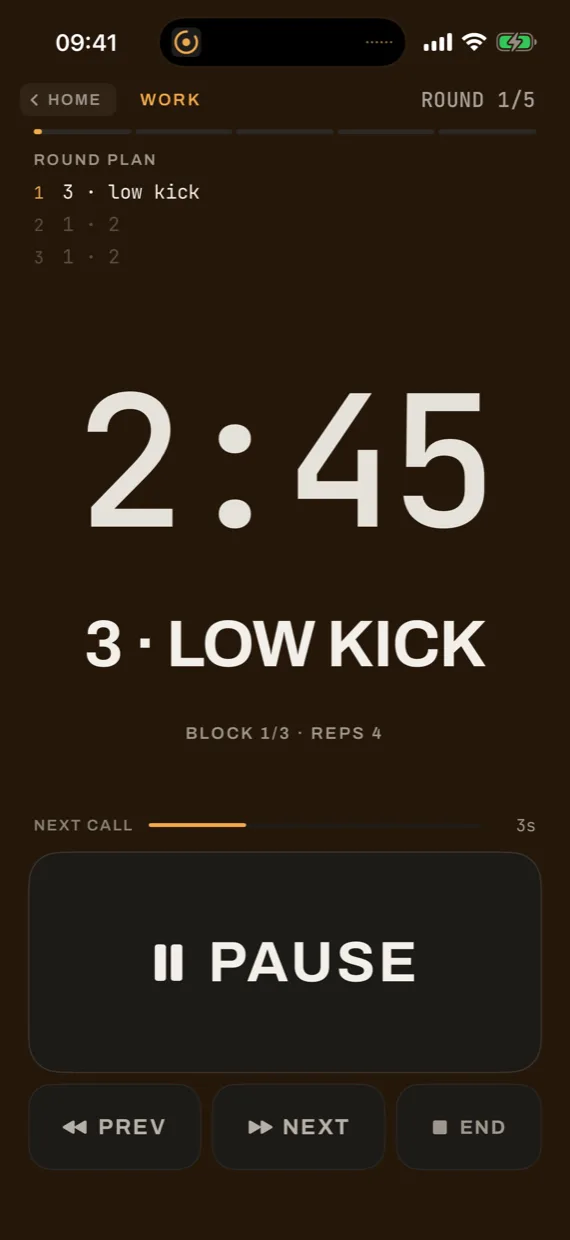
Nothing here needs to be looked at.
It has to keep going when the screen locks
Not “keep the screen on” — that just flattens a battery over five rounds. The audio has to survive the lock, the pocket and the silent switch. That takes a native audio session declared for playback, an engine that keeps running through its own silence, and the background audio mode. A web page on iOS can do none of the three, and an app that is a web page in a shell inherits the limit. Thirty-one reviews in this category describe a round going quiet partway through; that is what this looks like from the outside.
It must not take your music
The most-praised trait in the whole review corpus is an app that leaves a playlist alone, cited ahead of the content. The trap is that asking iOS to duck other audio holds for as long as the session is active — which is the whole round. Ask per call instead, on a window that closes itself, and the music drops for a second and comes back.
The calls have to be words
Numbered calls work for hands and stop at four. Past that the numbering is not portable between gyms, and there is no number for a teep, a check or a collar tie. The cost of a numbered call is written plainly in one review of another app: “if you don't mind constantly looking at your phone to figure out what move the number correlates with, this is the app for you.” Looking at your phone mid-round is precisely what a talking clock exists to stop.
Straight answers
The settings, answered
How long should a heavy bag round be?
Three minutes with one minute of rest is the amateur boxing round and the default most timers ship. Muay thai's own convention is five rounds of three minutes with two minutes in the corner, which is why the Muay Thai program in this app opens at exactly that and leaves every other program where it was. Neither is a training prescription: they are the shapes of the sport, and a round timer's job is to reproduce them without being touched.
How much rest between rounds?
One minute for boxing, two for muay thai. The more useful question on a bag is the rest between combinations inside the round, and that is where a single number stops working — see above.
What interval should the calls come at?
There is no correct single value, which is the whole point of this page. Across the eighty-nine combinations in this app the throw time runs from 0.35 s to 4.95 s, a factor of fourteen. Any fixed beat rushes the long ones and leaves you standing on the short ones. The gap has to be computed per call, from the strikes in it plus the bag's return.
Does a round timer need to keep the screen on?
It needs to keep working, which is not the same thing. Keeping a screen awake for a five-round session is a way to flatten a battery; what matters is that the audio survives the screen locking, the phone going in a pocket and the silent switch being on. Thirty-one reviews across this category describe a session going quiet partway through, and that is what the defect looks like from the outside.
Can I use it with my own music?
You should be able to, and it is the single most cited reason people stay with an app. Here the music keeps playing and is only ducked around each call, on a window that closes itself, rather than lowered for the whole round.
Read next
- Every muay thai and boxing app, read through its reviewsWhat 2,327 App Store reviews say goes wrong, ranked by how often it is written down.
- Eighty-nine muay thai combinations, timedThe whole catalogue, from a 0.35 s jab to a 4.95 s six-beat sequence, with the timing behind it.
Compared with
- Boxing Timer Pro Round Timer82 one-star reviews out of 215, all after a one-time purchase became a subscription.
- PunchLab344 reviews read. The strap, the $80 a year, and the music it turns down for the whole session.
- Shadow Boxing Workout AppIts own five-star reviews ask for muay thai. This is what that app would be with legs.